Kinematic detection under adversarial optimization.
Kinematic Features Are All You Need: Detecting Synthetic Mouse Trajectories Under Adversarial Optimization
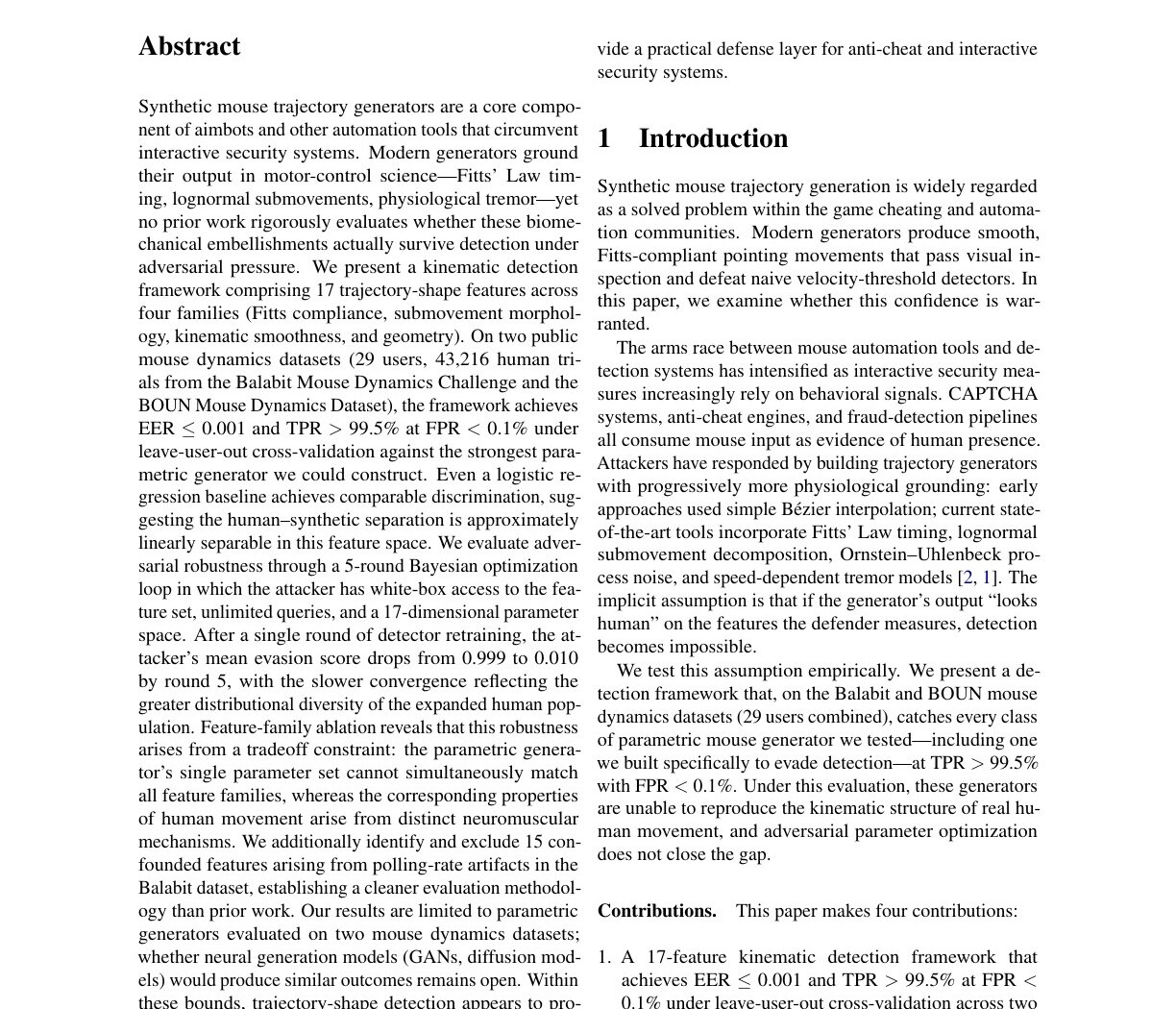
Modern mouse generators borrow from motor-control science: Fitts' Law timing, lognormal submovements, physiological tremor. The paper asks whether those additions actually hold up when a detector measures the shape of movement instead of how human it looks.
Across the Balabit and BOUN mouse-dynamics datasets, the 17-feature framework reaches an equal error rate at or below 0.001. After one detector retraining round, a white-box attacker's mean evasion score falls from 0.999 to 0.010 by round five.
Contributions.
The evaluation indicates that a single parametric generator cannot satisfy every measured human movement constraint at once.
- 01
A detector built only from raw x, y, and time trajectories, with no hardware fingerprinting or spectral shortcuts.
- 02
Five rounds of white-box Bayesian optimization that fail to sustain evasion after one detector retraining round.
- 03
A taxonomy of 32 kinematic features across six families, including 15 polling-rate confounds that should be excluded.
- 04
SigmaDrift, an open-source motor-control generator for future trajectory detection research.
Paper and source.
The PDF, archival record, detector implementation, and generator article are linked below.
Mouse dynamics / adversarial ML / motor control / anti-cheat / behavioral biometrics